
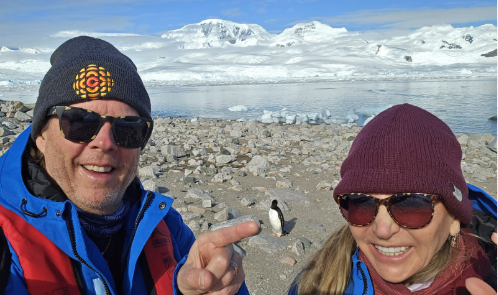
Masha and Rob Glanville have been to all but one country on Earth. They don’t feel they are anywhere near done adventuring.
By Mitchell Fox | April 10, 2026
Masha and Rob Glanville have seen a lot of the world. And yet, they find their minds blown all the time.
This time, it was penguins. Though they’d just been to Antarctica, the sight of hundreds of King Penguins at Volunteer Point on the Falkland Islands was unlike any other they’d experienced. “Surreal,” is the word they choose for the visual of penguins all around them, surrounded by vast beach and see-through, turquoise water.
Next, it might be the crab migration on Christmas Island. Or wild orangutans in Sumatra. It doesn’t matter exactly, as long as it is a suitable next stride in their great globe-trot.
“Home is wherever the two of us are, and it can be anywhere in the world,” said Masha.
The Glanvilles are nomads who spend their time bouncing from region to region, collecting experiences. They have been to all but one country in the world and as of this year, have visited all seven continents. They are hardly the first to achieve such feats, but that’s not the point for them or for many others who have undertaken a nomadic, travel-centric lifestyle—the objective is new experiences.
“Now we’re just looking at the Earth as a spherical wonderland. We don’t care about the countries so much. It’s more about ‘Where haven’t we been?’” said Rob.
“Except for North Korea,” Masha interjected. “We have to finish North Korea.”
The Democratic People’s Republic of Korea is the only recognized country the couple has not visited. They’ve travelled to the rest of the 193 recognized United Nations member states and the sometimes-recognized nation states of Palestine and Vatican City, as well as Kosovo and Taiwan. They’ve also been to many territories and nations, such as the Falkland Islands and Tibet.
The Glanvilles sold their home in California in 2017. After their family dog died, they went global. Most of the year, they use air miles and cheap flights—and occasional boats or trains—to navigate a region they select based on their interests or new experiences.
They travel with only a backpack—limited to about 10 kilograms to fit most airline carry-on limits—buy essentials as they go and sometimes wash their clothes in sinks or bathtubs. They understand the nomadic life may not be for everyone but at this point, it’s the only lifestyle they can imagine for themselves.
“Even buying a few pieces of clothing, I start to feel claustrophobic. ‘Oh my god, I’m accumulating things. I’m nesting,’” Masha said. “Settling down does not interest me whatsoever. So yes, we’re nomadic, and we love it.”
Temporary homes, permanent connections
Every three months, the Glanvilles return to Toronto to visit family. They also spend time in Vancouver over the summer. Not owning a home, they spend this time house-sitting—taking care of people’s homes and pets while they are away in exchange for a place to stay. It’s a diversion from their usual lifestyle, as house-sitting is usually done for weeks, not days.
“Our lifestyle has no routine but having the responsibility of taking care of someone’s house, in effect, is a routine,” Rob said.
In 2024, the Glanvilles joined TrustedHousesitters, a website that facilitates pet- and house-sitting for owners and travellers all over the world.
Angela Laws is the head of partnerships and engagement for TrustedHousesitters and a former nomad—she moved around the world house-sitting for six years after her beloved dog, Holly, passed away.
“She had more air miles than some people,” Laws said of the Springer Spaniel.
Now living in Scotland, she sees house-sitting as an affordable and accessible way for people to build travel and all of its benefits into their life, while also embracing their love for animals.
“Not everybody [travels], not everybody wants to do it, but I think once you start, you realize how small the world is. You also realize there’s so much more that binds us together than separates us,” she said.
The main reason the Glanvilles will not get to North Korea this year is the country cancelled its marathon in April. It meant a lost opportunity to get into a country that has cracked down on foreign connections and is strict on tourists.
Their back-up plan involved a tour into the country. This also fell through, as they recently found out the tour dates coincide with a house-sit they have booked in Vancouver. While devastated not to get to their final country, Masha and Rob are thrilled to return to Ben, a dog they connected deeply with in North Vancouver last year.
“It’s going to be amazing, because it’s coming home to these animals that we fall in love with,” Masha said, adding it can be good to stop back in Canada and reset.
Laws says pet-care is 99 per cent of what TrustedHousesitters does, as most members use the site to connect with other pet-lovers who can care for their dogs, cats and other animals.
“If the animals weren’t part of TrustedHousesitters, I don’t think TrustedHousesitters would exist,” she said.
A 2025 study in Social Indicators Research found a correlation between pet companionship and satisfaction, including that spending time with a pet can be worth up to €70,000 in life satisfaction over the course of a year.
The nomad trend
The Glanvilles are hardly the only nomads out there in 2026. In fact, they have gotten to know many others like themselves, some who have become close friends.
“Family, friends, they really don’t understand what they’re doing, and honestly, they’re not that interested. They may feign curiosity or interest, but they’re not. They’ve got their lives that are very structured, and they just can’t understand ours,” Masha said. “Meeting up either virtually or in-person with people that are trying to do the same thing as we are…there’s that shared curiosity.”
One person who does understand to a degree is Wendy Arbeit. She completed her journey to 195 countries in early 2025, reaching North Korea as her last stop. For her, it was a major milestone on a journey that began with her twin sister almost 30 years prior.
After their cat died in 2006, she and her sister sold their townhouse in Virginia and increased their travelling, eventually learning of the Traveller’s Century Club from a man in Turkmenistan.
The Traveller’s Century Club (TCC) is an international nonprofit social organization for travellers who have been to 100 or more countries. Their list features 330 destinations, including all of the world’s countries and a vast collection of territories and islands, of which Arbeit has been to 320.
“It’s my passion, it’s my reason for being,” she said. “But I don’t know if I could have seen every country in the world without taking off and doing it as a full-time endeavour.”
Why travel?
In 2025, travel journalist and speaker Ash Bhardwaj released “Why We Travel,” a book detailing 12 motivators—including curiosity, serendipity, healing and hope—that influence people to leave their homes for a trip and if recognized and acted upon, help them make the most out of their travel.
For Bhardwaj, travelling comes with all sorts of ways to discover oneself and the world around them.
“Travel is a mechanism. It’s a tool to allow you to do other things. It can give you first-person direct experience, which is both more emotionally engaging and allows more cognitive engagement,” he explained. “If you set it up well, you can expand yourself in ways that you can’t just when you’re at home.”
Bhardwaj has travelled extensively in his life, mostly for work as a journalist and filmmaker but also as a student, a teacher, a ski instructor, an army reservist and a grieving son after his mother’s death. Now, though, he finds settling at home with his wife and two young children to be “the most fulfilling thing I’ve ever done.”
He says it’s “brilliant” nomads like the Glanville’s find a way they like to spend their life on Earth. Nevertheless, he says that comes with economic, social and geopolitical privilege, as not everyone can get away from work or get Visas.
“I guess you only have that freedom of travel if you’ve already got economic freedom, right?” he said.
Travel, he says, is an instinctive driving force that people save lots of money throughout their lives for.
“If we all had more money and more time, then we probably would travel more,” he added.
Arbeit says she most likely won’t get to all 330 TCC countries in her lifetime, as some are too difficult or expensive to get to. But that’s OK with her.
“Now I’m not trying to tick things off as much as I want to see things that interest me,” she said.
She says travel has changed her life and her perspective.
“The world is so great. There’s so much to see. There’s so much to do. I think everybody should go, whether it’s like cruises or hiking or whatever interests them,” she said. “Life’s too short just to do nothing, you know?”
Laws is in a new part of her life, with her nomadic days behind her but travel and pet-sitting as consistent passions. She doesn’t see a need to check boxes or find new experiences as she may have a few years ago.
“It’s the people that matter to me. It’s sharing that time together,” she added.
The Glanvilles, meanwhile, will continue in their nomadic ways. They are currently in Thailand, walking new neighbourhoods of Bangkok, getting bloodwork and healthcare done and figuring out their next stop.
They’re pretty sure it will be Sumatra. It’s just a short flight away and it’s a good time of year to hike to see the wild orangutans, which can only be found in a small number of places in the world. For them, as animal-lovers too, it is important to find animals not kept in cages or confined spaces.
“We’re always hunting for being able to see something new, new life that we haven’t seen before in the wild,” said Masha.
That pursuit of something seems like it will last far beyond Sumatra, or whenever they finally get to North Korea.
“I’m actually quite proud of it now that I think about it as a whole globe, how we’ve been spinning around, but not really going back to the same place that often,” Rob said.
— 30 —