
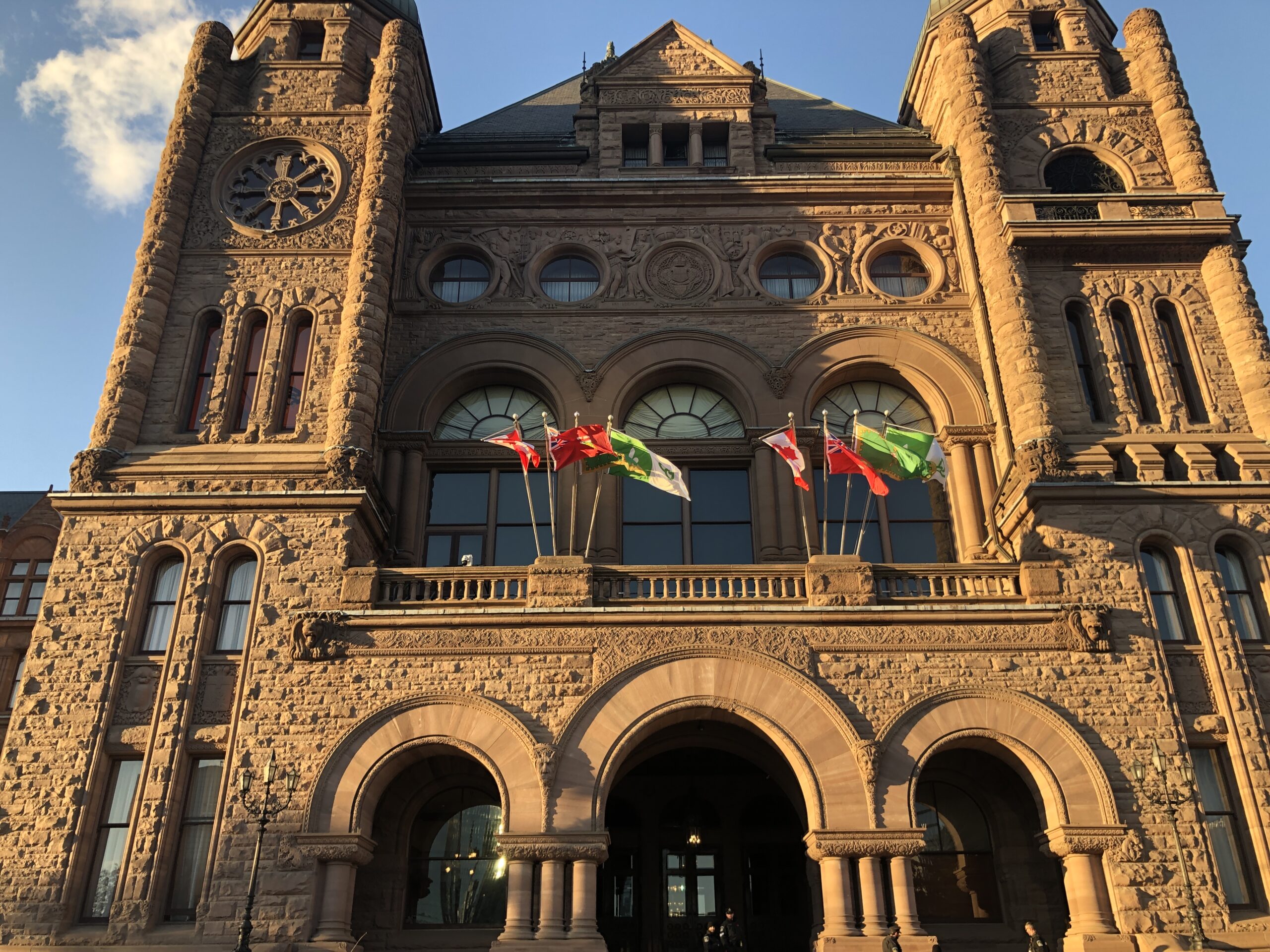
For Queen’s Park journalists, information can be hard to come by. Doug Ford is seeking to make it even more difficult
By Mitchell Fox | March 24, 2026
*Some answers in this article have been edited for length and clarity.
For journalists in Ontario, Doug Ford’s government’s desire to except himself and other public officials from Freedom of Information (FOI) requirements is a sign of information becoming even more elusive.
The Ontario government announced on March 13 it intends to introduce a bill exempting the the Premier, cabinet members, parliamentary assistants and all their offices—thus including most of Ford’s Conservative MPPs—from having to respond to FOI requests. For journalists, this means documents, emails and schedules housed in these offices will no longer be accessible.
The proposal comes in the aftermath of a decision by a panel of judges in January that Ford’s phone being used for provincial business meant it should be subject to FOI requests. He confirmed on March 17 the government’s clampdown was tied to protecting his phone.
Jeff Gray is a Queen’s Park reporter at The Globe and Mail and has covered the Ford government since 2019. I caught up with him on Tuesday to discuss what the proposed bill could mean for public information in Ontario.
Q: Hi Jeff. Thanks for joining me. You are at Queen’s Park every day and write a lot of stories about this government. Can you break down for me how big a deal this proposed bill is?
Jeff Gray: The impetus for this, it would appear, is a lengthy FOI battle over the Premier’s personal cell phone. It is generally accepted fact that he uses his personal cell phone for government business—he hands out his phone number at events and must get hundreds or thousands of texts and calls. Global News and a private citizen were in court trying to get a look at those to find out who the Premier was talking to and when, in relation to government business.
Obviously, it’s pretty unusual for a premier or someone in that position to use their personal cell phone in that way. So that is sort of a unique issue for Ontario.
But the phone maybe is a separate thing. We’ve never gotten our hands on phone or text records. Through FOI requests, though, we have been able to see things like emails between officials.
We’ve been able to see schedules, so you could see the Premier’s meetings in his diary, who he met with, who he is going to meet with, and when. That’s been useful for various stories that we’ve done. That will all be hidden now, unless there’s some document that exists on the ministry side that gives you some of that information.
Ontario’s Information and Privacy Commissioner [IPC] Patricia Kosseim has called out Ford’s government for using their personal devices. She’s also been critical of what appeared to be attempts to circumvent FOI searches by using code words, like The Greenbelt was referred to as “G*”.
Q: Stephen Crawford, Ontario’s Minister of Public and Business Service Delivery and Procurement, said FOI laws in the province were outdated and these changes would align with other provinces. But you and Tom Cardoso reported some differing accounts on that front—only the federal government, Nunavut, Saskatchewan and Quebec explicitly exclude ministers’ offices. Can you explain what’s going on there?
JG: We’re actually still working on some of that, because as you can appreciate, FOI legislation is very complicated, and sometimes what’s written down is less important than how it’s applied. But the government’s line has been—and this is reflected in materials that were distributed summarising the bill and the rationale for it—that only Ontario and Nova Scotia have completely unfettered FOI access to these offices. So, they say they’re just lining up with most other provinces and the federal government.
Kosseim has made a couple of statements disputing that, and I’m actually hoping to speak with her to sort out exactly what she means. But she has said that the proposed changes will make Ontario on the other side of the ledger, more restrictive than other jurisdictions.
Q: You’ve been reporting at Queen’s Park for a few years now. Can you tell me where this FOI discourse fits into your experiences with this government, or with governments in general?
JG: I started at Queen’s Park in 2019 having done a lot of time as a city hall reporter for the Globe. I found City Hall to be a way more wide-open building generally, leaving aside the issue of FOIs. Just as far as information flow, getting answers from a government, getting details, figuring out what the city is doing and why, it was way more open than the way things are done at Queen’s Park, where the government really restricts the amount of information it puts out.
I joked when I came here that the government says it’s doing something, we ask why and what impact will have, they don’t tell us. Then we ask the opposition, and they don’t know much about it either, but they hate it. And then we go back and write our story and we need other sources of information to figure out a lot of what the government is doing. And in fact, a lot of it, you can find out more about it from a municipality. There’s so many documents produced to the city council where the staff are saying this funding cut, this policy change will affect x, y, z. Much of what the province does is actually write a cheque for someone else do it—that someone else is often a municipality.
I think generally, governments have gotten more restrictive with information. And the FOI process, it’s a mess. The deadlines are missed. It takes forever to get anything. It’s all blacked out of it. And it’s a real struggle to get a lot of good information out of it.
Q: Speaking of the FOI process being a mess, the Globe completed a project a couple of years ago called Secret Canada that unearthed FOI issues across the country. Being in that newsroom, how much does this means for your information gathering?
JG: For me, being more in the daily grind, when you’re on a different story every day, and you file an FOI, you’ve got to wait 30 days—now it’ll be 45 days—and then there’s an extension and then they ask for clarification. And you’ve got to appeal it to the IPC, where I don’t remember what the FOI was. I moved on. I’ve written 200 other stories.
It’s a tool that can be used, and we do use it. I do use them. I do file them. But I’ve found it to be pretty frustrating. And there are sources—human sources—to get you information that are often quicker.
Q: As you mentioned, the proposal includes a change to how long the government has to respond to FOI requests—to 45 business days from 30 calendar days—and allowing the government to request two deadline extensions, rather than one. When your colleagues did the Secret Canada project, they found Ontario had one of the longest wait times for FOI requests to be fulfilled—an average of 122 days. With these changes, is this only going to get worse?
JG: Yeah. I mean, maybe you’d say, “Well, at least they’ll be more realistic with the timeframes.” But yeah, there’s no question Secret Canada really revealed a whole bunch of problems with the system—it is pretty onerous.
Now, the one point the government makes is, when the system was designed, there was no email, there were no text messages and so you were dealing with maybe fewer documents, less volume. And this is a problem, I think. You know, lawyers, litigate. If you’re trying to sue a company or something, all of a sudden you’ve got a million emails to go through. This affects everybody. But for FOI, if you have to go through every email and figure out if it’s got information that should be exempted, these processes take a lot of time.
Almost no one had cell phones when the law was first drafted and adopted in 1988 and so maybe it was easier to get landline phone records. I don’t know.
Q: The Ford government has been busy lately, with proposals affecting the Ontario Student Assistance Plan (OSAP), the Billy Bishop airport and more. What does this proposal say about the direction and sort of the way that this government operates?
JG: I don’t think you have to look very far to find critics of government who will say that they have been secretive. They don’t like to talk, answer questions or explain what they’re doing.
I find it’s difficult sometimes just to get some basic facts about certain policies. They’ll say, “Well, the Premier is out every couple of days, we have press conferences” and so on. But the kind of detail and information we need to operate is hard to get out of one question, one follow-up, maybe 15-20 minutes. And in availabilities, the Premier is often not well-versed on things. He speaks in generalities, typically.
I think they definitely, at times, see the media as a problem or as an issue to be managed, rather than just straight up answering questions and providing information about how they are handling billions of dollars on behalf of Ontario taxpayers.
Q: MPPs returned to Queen’s Park yesterday. To your knowledge, are the FOI changes front of mind there now, especially for MPPs from other parties?
JG: In both question periods we’ve had now, the opposition has raised it. They also raised the phone log of the Premier’s phone.
On the other hand, the premier sort of said, “Look, nobody cares about FOIs except for the media and the opposition.” And he might be right about that. But that doesn’t make it right. That doesn’t win the argument, just wins the politics of it.
We’ll see. The opposition has to gamble on what issues they want to emphasize, what they think will stick and what people can relate to. Even just using the term FOI, there are a limited number of people who really know what that means. But if you’re talking about gas prices, emergency room waits or changes to OSAP, those are things that more people outside the bubble of Green Park understand.
So there’s always that piece of what issue the opposition is going to raise. They can talk about it all they want, but it’s going to come to the House, and Ford has a large majority, and so it’s going to pass.