
By Mitchell Fox
As early as the seventh grade, Patricia Corcoran knew she wanted to be a geologist. Inspired by third-grade lessons about rocks and minerals, she became the type of person who knew what they wanted to do at a young age and never strayed from that path.
But that seventh-grade student probably never thought she would devote her life to researching plastic.
Corcoran is a professor in the Earth sciences department at Western University and the lead of “Where Grains Meet,” a research team focused on microplastic pollution in sedimentary grains. She is also the co-founder of the Synthetic Collective, a group of scientists and artists working together on research projects across the Great Lakes and putting together sustainably curated exhibitions based on their findings. With these and her many other projects, Corcoran’s life is dedicated to perhaps not the most alarming form of pollution, but the most abundant.
“Microplastics have been found in placentas, in the heart, in the lungs. It’s not hard to imagine, right now, we are breathing in microplastics,” she said. “Everything is plastic. All fabrics, everything. And that’s why there’s so many micro-fibres everywhere.”
For Corcoran and the other researchers involved, “Where Grains Meet” and the Synthetic Collective are part of an inter-disciplinary effort to inform people around the world about plastic’s abundance and impact, especially in its smallest forms. From research to exhibition, they are building up an understanding of how one of humanity’s biggest inventions becomes part of the environment.

Dr. Patricia Corcoran says she likes to remind people everything in a room is made from the Earth. Like a shrine to that fact, her office is home to all kinds of plastics she’s collected. (Mitchell Fox/MMJC) 
Outside Corcoran’s office, her focus and pride in her work is clear. Inside, it’s even more so. (Mitchell Fox/MMJC) 
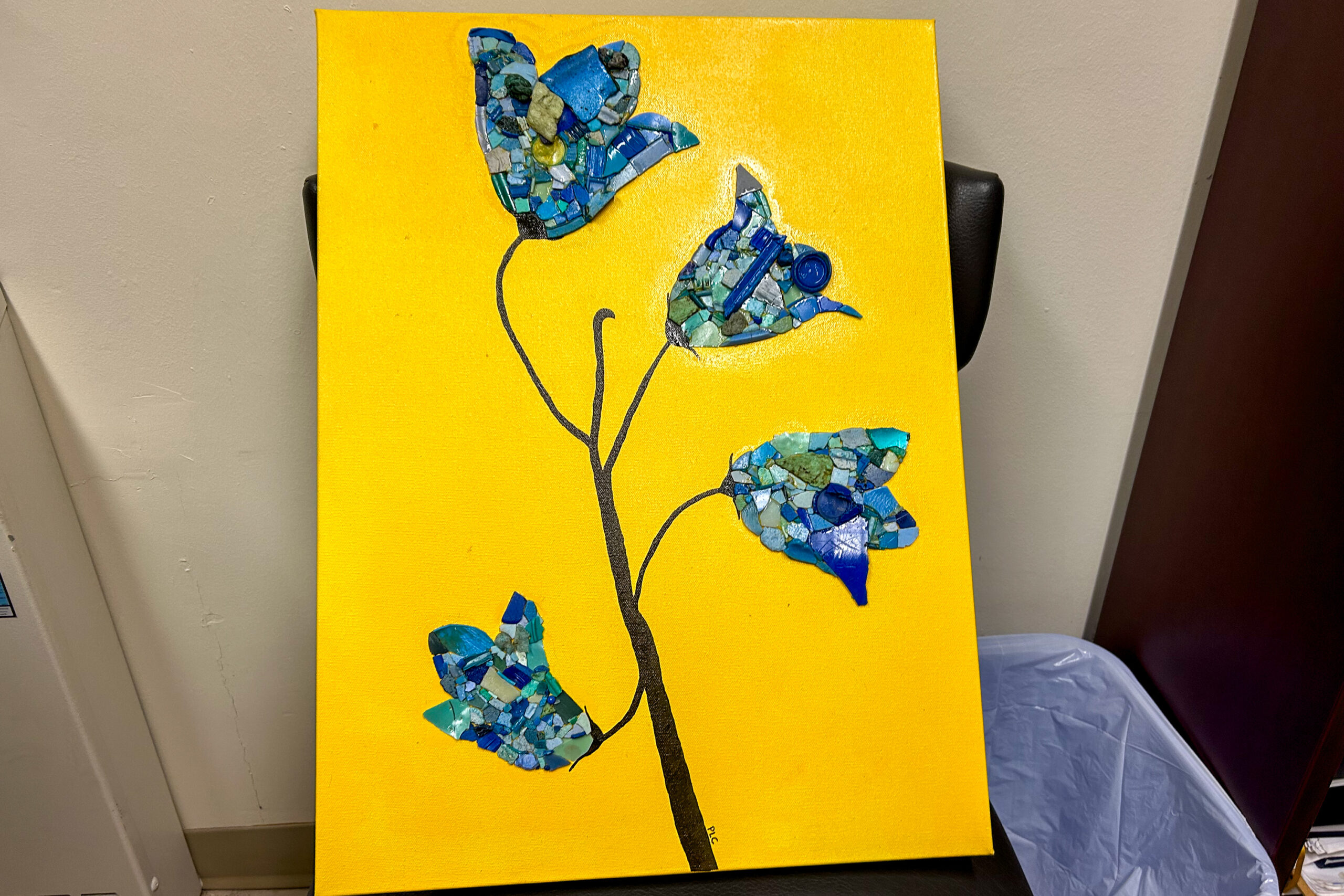
Rocks, family and plastics take up a good portion of Corcoran’s life. (Mitchell Fox/MMJC) 
Her work with artist Kelly Jazvac began with plasticglomerates, or plastics fused with sediment and other plastics. (Mitchell Fox/MMJC) 
Corcoran keeps a bowl of plastics collected on the Great Lakes that she calls “confetti.” (Mitchell Fox/MMJC) 
Rope and lobster traps are also plastic, Corcoran points out. And they fuse with grains of all kinds. (Mitchell Fox/MMJC) 
Over time, certain sea or dune grasses collect all kinds of plastic as they roll around. (Mitchell Fox/MMJC)
As a sedimentary petrologist, Corcoran focuses on “sedimentary grains,” including rocks, sand and the anthropogenic grains, or man-made microplastics, mixed in with them. In 2008, while in Hawaii researching heavy minerals, she came across “all kinds of plastic” on the beach and started to study the phenomenon. She later partnered up with researchers who found plastic pellets—the raw products of fossil fuel production used to manufacture plastic items—and other plastics on waterfronts across the Great Lakes.
Many years and government partnerships later, Corcoran has worked with graduate students to develop methods for separating plastics from sand and examined plastic concentration in both sediment and fish stomachs of the Thames River, London’s stormwater ponds, the Great Lakes and beyond.
“For me, I look at [plastic pellets] as when I find it on a beach, I see it as a grain. It’s not a grain of sand, but it’s an anthropogenic grain,” she explained. “It’s a human-made grain, which was never meant to be there, obviously, but it is now, so now it is part of the environment.”
Corcoran said plastic is a unique issue because it is used everyday, can’t be measured like other pollutants and creates harms people don’t see firsthand, outside of the occasional video of a trapped seal, turtle or bird.
“Of all the types of pollution, plastic pollution is one of the most globally significant in that it’s everywhere. There’s no place on Earth that people have been and studied…where you have not found plastic,” she said, adding that organic pollutants like mercury also attach to microplastics, which are hydrophobic.
Corcoran calls plastic pollution a Wicked Problem because it is global and requires efforts from multiple disciplines and levels to solve.
“Where Grains Meet” is one piece in that puzzle. The research group includes PhD candidates, graduate students and professors from Western who run projects focused on the make-up of sediment, including natural grains and human-made ones embedded in the environment. Many focus on studying the type, attributes and origin of plastics around the Great Lakes and the Thames River.

Corcoran’s “dry lab” is a storage space for all of the samples yet to be or already studied (Mitchell Fox/MMJC) 
Along with sorting plastics and microplastics, Corcoran does AI training for compositional data. (Mitchell Fox/MMJC) 
Corcoran’s lab works to identify what plastics are made of and where they come from, hopefully leading to mitigation (Mitchell Fox/MMJC) 
Corcoran’s researchers are meticulous about sorting their samples (Mitchell Fox/MMJC) 
Plastic pellets all have distinct features. (Mitchell Fox/MMJC) 
“Scientists are hoarders,” Kelly Evans says. “We don’t throw anything away.” (Mitchell Fox/MMJC) 
New types of plastics are introduced all the time, Evans says. For example, commercial cannabis products now show up in samples (Mitchell Fox/MMJC)
Jiali Feng has been working in Corcoran’s lab for four years as a PhD student. Her research on plastic in the air, water and land on the reserve territory of the Chippewas of the Thames First Nation is the first documented on the First Nation.
“Before this research, no one knew anything about microplastics. We just want to establish a baseline pretty much about this pollution source,” she said.
Now she says, the community is learning from the data she and Corcoran are providing, as well as educational sessions they’ve held for the community. At the same time, as an international student, she is learning from a group of people she knew little about before starting the project four years ago.
“In this process of doing this research, I’m learning about their culture and their perspectives of this world,” she said.
She said it is “fascinating” to work in the lab and learn from the researchers around her. She did a Master’s degree in microplastics pollution at Western, but she is still learning.
“Studying here at Western and obviously in this lab, it’s pretty much opened my eyes,” she said.

Corcoran’s “wet lab” is filled with samples and equipment. No space is wasted and the vastness of the group’s work is clear. (Mitchell Fox/MMJC) 
Each sample Corcoran’s lab collects can have just a handful of microplastic fragments on them, while Evans says she has seen others with up to 14,000. (Mitchell Fox/MMJC) 
The first step in analyzing samples is drying them out in an oven (Mitchell Fox/MMJC) 
Many samples are put through a separation process using density tools. (Mitchell Fox/MMJC) 
For each location, researchers have a tray of samples. (Mitchell Fox/MMJC) 
Each slide has a large collection of microplastics on them, including different colours and types of plastic. Each is circled in black marker. (Mitchell Fox/MMJC)
The lab is also home to research on plastics found far from home. Kelly Evans, Corcoran’s lab assistant, focuses her work on microplastics in arctic communities, including local pollution and long-range transport of plastic particles. The idea is to mitigate plastics getting to the arctic and make sure plastic pollution is managed as the arctic develops.
Evans’ focus during her undergraduate degree was on pesticides and contaminants, but developed into how plastic can be a contaminant. When she looks under a microscope now, she sees it as a “hunt” for unique particles or those that can teach her and future researchers about where plastic comes from.
“Just the concept that, this artificial material that is micro-sized exists—like we produce this. You can’t see it with the human eye, and yet, it exists because of humans. It doesn’t exist because it just naturally occurs—was a concept that I was really interested in,” she said.
For Evans, the research is all about being one chapter in a story that progresses in terms of learning more about plastics and where they come from, then mitigating its prevalence and impact.
“One research project answers one part of the story, and then you build that project by doing another project, and then that builds on the story,” she said. “It’s through the combination of 100 research projects that paint the picture to policy. No policymaker looks at one research paper and then goes, ‘OK, no more plastic.’”

Kelly Evans, Patricia Corcoran’s lab assistant, focuses on microplastics in the arctic. (Mitchell Fox/MMJC) 
Under a microscope, researchers define features of individual microplastics. (Mitchell Fox/MMJC) 
The goal, Evans explains, is to learn more about the origin and prevalence of specific plastics. (Mitchell Fox/MMJC) 
Jiali Feng’s research is centred on microplastics in the air, sea and land of Chippewas of the Thames First Nation. (Mitchell Fox/MMJC) 
Corcoran’s lab includes a photographic microscope connected to a computer. (Mitchell Fox/MMJC) 
Feng’s research data is shared with the Chippewas of the Thames First Nation for them to do what they wish with. (Mitchell Fox/MMJC)
In addition to an opportunity to learn more about a specific dimension of how plastic travels and accumulates, Evans’ research also has a community element to it. Because of the climate and lack of infrastructure, working in arctic brings out new practices, such as studying moss and road dust.
“The techniques that we use to sample for plastics, they can’t always be the same. So, can we use road dust, which a community member could collect, and therefore it promotes community-based research and the inclusion of Indigenous knowledge,” she said.
When Kelly goes into an Inuit community, she likes to ask them what they want to see from a microplastics project. To her, community-based research is underrated, as “helicopter science”—where researchers gather samples and data in an area and leave without communicating with the local population—can be unjust.
“I’m just one person, right? But if we can get a whole community involved, and we can get a whole community learning right about one thing, they can start to see things a little bit differently too,” she said. “We as scientists can see things a little bit differently too, because they’re coming in with knowledge of their experience. We’re coming in with knowledge of our experience. [We can] put those together, then create a bigger picture.”
Creating a bigger picture is also the goal of the Synthetic Collective, which includes scientists such as Corcoran but also artists and cultural experts from across North America. The initiative was born after Corcoran invited Captain Thomas Moore, who discovered the “Great Pacific Garbage Patch”—which Corcoran clarifies is not a patch at all—to deliver a talk at Western. Afterwards, she met Kelly Jazvac, an artist who took an interest in the plastiglomerate pieces Moore spoke about. Together, they went to Hawaii for the study, resulting in a paper published in 2014 with Corcoran, Moore and Jazvac as co-authors.
“We missed our plane. We were so excited, like talking and talking and talking,” she said. “We spent 10 days on the island and got along so well.”
Kirsty Robertson, Canada Research Chair in museums art and sustainability in the visual arts department at Western, is a founding member of the Synthetic Collective. Her work surrounding plastic textiles—mostly made from fossil fuels—and Jazvac’s focus on found plastics came as they worked at the same department at Western.
With Jazvac’s involvement in plastiglomerate research and Robertson’s writing on plastiglomerate as art-adjacent as proof of concept of science and art together, the Synthetic Collective officially formed in 2017. Robertson said it started as a way to bring Corcoran and Jazvac’s research closer to London.
“Plastiglomerate had given this sense of how these objects that are art-adjacent could make a huge public impact,” she said.
The ultimate goal, though, is to reduce plastic pollution in the Great Lakes.
“We seemed stronger as an art science collective than we did as like separate people working on these issues,” she said.
As more scientists and artists alike got involved, the group began work on studies, papers, talks and exhibitions. Their largest project saw researchers paired with artists to collect plastic pellet samples at sites across each of the Great Lakes. They found pellets on 42 of 66 beaches and their conclusions included that pellets were more abundant and various on sites near large populations, close to a density of plastic industries or where plastic spills took place.
“I think we have had an impact on the knowledge about plastics pollution in the Great Lakes region, and then also accountability towards cleaning things up,” Robertson said.
In 2021, the Synthetic Collective put together “Plastic Heart: Surface All the Way Through,” an exhibition at the University of Toronto Art Museum. It presented research from the Collective’s study of plastic pellets on the Great Lakes, informed about plastic degradation and commented on how plastic has been used in art. They also aimed to be zero carbon.
An altered version of the exhibition then travelled to the Canadian Culture Centre at the Canadian embassy in Paris.

Robertson said museums have a role to play as teachers, while exhibitions like “Plastic Heart” also allow the researchers to mobilize information about plastics through websites, social media, catalogues and articles.
“Art has a very public presence, and it can be like very good teacher, but museums are known as trustworthy sources,” she said. “There’s so many things that come out of exhibitions and that come out of art making.”
Robertson said part of the goal of “Plastic Heart” was also to change museums from within, which she believes is happening.
“The ‘Plastic Heart’ exhibition definitely made a statement within the gallery,” she said. “It certainly questioned the norms of exhibition-making and drew attention to the way that museums and galleries were caught up in various systems that they might not even have been aware of.”

With her work now focused on sustainability within exhibition curating and Jazvac developing sustainable materials for art making, Robertson said it’s all about a “ripple effect.”
“Maybe not everybody is going to see an artwork and change their attitudes towards plastics, but it’s one piece of a puzzle, and together, that puzzle can have a huge impact,” she said.
Robertson said projects like the Synthetic Collective are more important than ever, even if the impacts can be hard to see when policy hasn’t completely followed.
“We can’t control everything. An individual can’t do everything but you can have impact in your own field or in your own way,” she said. “Sometimes it feels like you’re not making change, and then later you look back and realize that had you not been doing that work, things could have looked very different.”
Though a hard part to quantify, Evans and Corcoran also see policy as the end goal for their research. The key for Corcoran is finding results that tell researchers, then people, industries and governments, what can be done next.
“In the beginning, it was enough to say, oh, there’s plastic pollution here, and this is what it is. It’s not enough anymore,” she said.
Alongside its use in most manufacturing, plastic’s origin as a by-product of oil and gas production means it is deeply connected to long-standing, economically important industries in Canada. With policy based on research above economics, Evans believes the biggest change in plastics pollution could come from everyday people making informed decisions about plastic, such as saying no to unnecessary plastics at a fast-food restaurant or choosing to consume fast fashion minimally.
“It comes down to the everyday person. I think policy will follow, yeah, but I think we need more everyday people to change their mindset on plastic,” she said.
At the end of the day, Corcoran said, the goal is raising awareness. While scientists can present papers that are used within the community, the artists “visually transform” it and exhibitions provide access and education to the public.
“It’s very interdisciplinary, and I just think that way we can capture more people in what we’re trying to do, whereas I can’t go out there and say to the general public, ‘Here’s a scientific paper,’” she said.